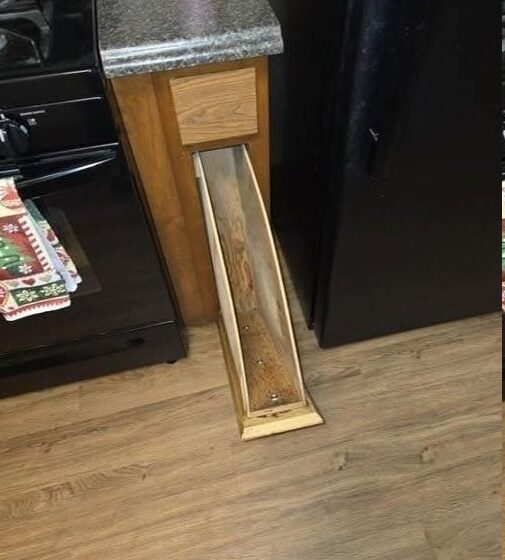
Moving into a new house is always an adventure. There’s the excitement of decorating, picking out furniture, and personalizing spaces — but there’s also the thrill (and occasional confusion) of discovering quirks, oddities, and hidden surprises left behind by previous owners.
For many homeowners, these discoveries are charming, funny, or at least curious. But sometimes, you come across something that leaves you scratching your head for hours. For us, it was a simple cabinet door — or at least, that’s what it looked like at first glance.
The Discovery: A Cabinet Door Unlike Any Other
When we first walked into the kitchen of our newly purchased home, everything seemed normal. The countertops were clean, the cupboards sturdy, and the pantry organized. It wasn’t until we started opening cabinets to check for any signs of pests or damage that we noticed it: a small, oddly designed cabinet door tucked into a corner, separate from the others.
At first, we assumed it was just a replacement piece left behind by the previous owner. But a closer look revealed something curious:
- The hinges were smaller than standard cabinet hinges
- There was a small cutout or groove that didn’t seem functional
- The size and shape didn’t match any other cabinets in the room
- The material felt slightly different — lighter, almost delicate
We were intrigued. Was this a hidden storage compartment? A cover for electrical wiring? Or perhaps a forgotten piece of some larger kitchen gadget?
Why Cabinet Oddities Aren’t Rare
It turns out that finding strange cabinet doors or fixtures in a home is surprisingly common, especially in older houses. Homes built before the 1980s often included custom woodwork and built-in storage solutions that modern buyers might not immediately recognize.
Some possibilities for unusual cabinet doors include:
- Appliance panels: Older refrigerators, dishwashers, or trash compactors sometimes had wood panels that matched the cabinetry. These panels could be removed and stored elsewhere.
- Hidden compartments: Before the age of security systems, homeowners occasionally built small secret compartments to store valuables or important documents.
- Specialized storage: Certain cabinets were designed to hold specific items, like cutting boards, spice racks, or baking sheets.
- Electrical or utility access: Some cabinet doors conceal fuse boxes, plumbing access points, or water shut-off valves.
But none of these possibilities quite fit the cabinet door we found.
Investigating Its Purpose
Determined to solve the mystery, we decided to conduct a little “home archeology” to figure out what this cabinet door was for. Here’s the approach we took:
Step 1: Measuring and Comparing
We measured the door carefully and compared it to the rest of the cabinets in the kitchen.
- Height: 12 inches
- Width: 8 inches
- Depth: thin panel, not designed to hold weight
No standard cabinet opening matched these dimensions. It was clearly not intended as a replacement for existing cabinetry.
Step 2: Examining the Hardware
Next, we inspected the hinges and latch:
Hinges were small, brass-plated, and slightly ornate
- No magnetic or mechanical latch was visible
- There were faint scratch marks near the edges, suggesting frequent use
The hinge style hinted that the door might have been installed for something lightweight — perhaps paper, fabric, or small household items.
Step 3: Checking the Walls
We tried holding the door against nearby walls and openings to see if it could have been a cover for something hidden. Sure enough, we found one wall with a shallow recess behind it, but it was too small for anything practical.
Step 4: Asking the Experts
At this point, we turned to the internet and local home improvement forums. Posting a photo of the door, we got several theories:
- Breadboard holder: Some older kitchens had vertical panels for storing cutting boards.
- Built-in ironing board: Certain cabinet doors concealed fold-out ironing boards, although the size seemed off for ours.
- Mail or message slot: Some homeowners built little doors to pass notes or mail between rooms.
- Spice or tea compartment: Tiny cabinets were sometimes designed for specialized food storage, especially in European homes.
The comments ranged from plausible to bizarre. One suggestion even proposed that it was a tiny “home bar” cabinet for storing miniature liquor bottles!
The Historical Perspective
Sometimes the best way to understand a mystery object in a house is to look at history. Depending on the age of your home, design quirks can make sense in context.
Our home was built in the early 1950s, which gives some clues:
- Post-war kitchens often included clever, space-saving features, especially in small homes.
- Cabinet makers frequently customized kitchens with narrow doors to fit small items like trays, recipe cards, or cleaning supplies.
- European influences were popular at the time, which sometimes meant including small, specialized storage compartments for tea, spices, or linens.
With this historical lens, our mysterious cabinet door could very well be a relic of a bygone era — a clever feature that no longer fits modern lifestyles.
Could It Be a Secret Compartment?
The idea of secret compartments in homes is fascinating. In older houses, these were often used to hide:
- Valuables like jewelry, coins, or cash
- Family documents and letters
- Alcohol or tobacco (especially during prohibition in the US)
While our cabinet door didn’t reveal any hidden stash when we removed it, the possibility that it was intended for discrete storage is tantalizing.
The thrill of imagining previous owners hiding small treasures or notes behind that door makes the mundane act of cleaning the kitchen suddenly feel like a treasure hunt.
Practical Theories
After weeks of speculation and research, we narrowed down some practical possibilities:
- Vertical cutting board or tray storage:
Many mid-century kitchens had narrow doors that opened to hold cutting boards upright. The dimensions of our door seem consistent with this use.
- Small utility compartment:
It could have been used to store small cleaning tools, gloves, or cloths — items you might want to keep close to the sink but out of sight.
- Recipe or note holder:
Considering that scratch marks were visible, it’s possible someone used it frequently to store recipes, grocery lists, or household notes.
Each theory has merits, but without a time machine or testimony from the previous owner, we may never know for sure.
One of the joys of owning an older home is that every corner tells a story. Not every question has an answer. Some objects — like our mysterious cabinet door — are relics of the past, reminders that houses evolve with the families who live in them.
Rather than feeling frustrated by the lack of clarity, we’ve chosen to embrace it as a conversation piece. Guests are intrigued, neighbors are curious, and we find ourselves imagining elaborate, whimsical explanations — from a tiny puppet theater to a mini library for recipe cards.