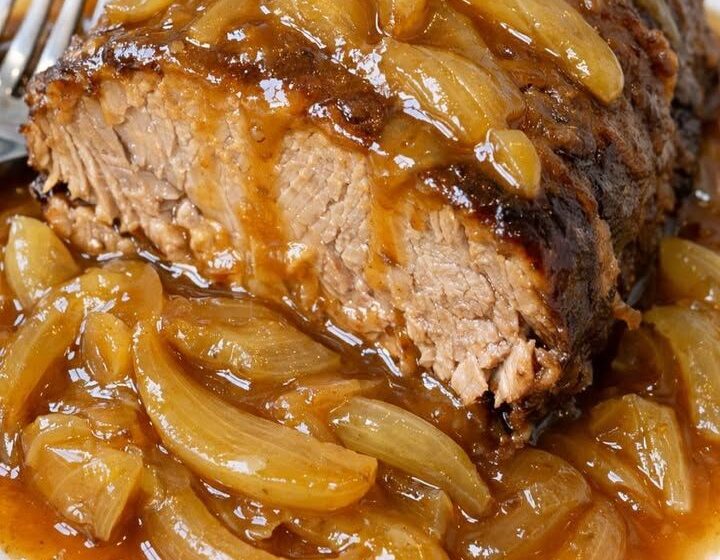
Slow Cooker Amish Onion Gravy Pork Roast
A pork shoulder roast is one of those cuts that rewards patience more than almost any other. Left in a slow cooker for the better part of a day with very little encouragement, it goes from a dense, economical piece of meat to something that yields to a fork with almost no resistance — deeply tender, richly juiced, and fully saturated with whatever it’s been cooking in. This Amish-style recipe provides exactly the right environment for that transformation to happen: a thick bed of sliced yellow onions beneath the roast, two envelopes of dry onion soup mix layered on the onions and pressed into the meat’s surface, and enough beef broth to create the slow-cooking liquid that becomes, by hour eight, a caramel-colored onion gravy that’s arguably better than the pork itself.
Four ingredients, one pot, eight to ten hours of unattended cooking, and what you get is Sunday dinner in the truest sense — the kind that fills the house with fragrance for hours and arrives at the table looking and tasting like you spent the afternoon in the kitchen. The Amish cooking tradition that inspires this recipe understood something that modern cooks sometimes forget: the most satisfying food often comes from the fewest ingredients used thoughtfully, with time doing the work that technique can’t replace.
Why This Recipe Works
The genius of this particular combination is the dual role played by the onions and the onion soup mix, both of which contribute to the finished gravy in complementary ways. The fresh sliced onions break down completely over the long, moist cook, releasing their natural sugars and transforming from pungent raw alliums into something silky, sweet, and deeply savory. The dry onion soup mix provides concentrated seasoning — dehydrated onion, onion powder, salt, and a blend of savory flavorings — that saturates both the meat and the cooking liquid with a rich, complex depth that would take hours of additional cooking to build from scratch.
The placement of the roast fat side up is an important detail. Pork shoulder and pork butt typically have a fat cap on one side, and positioning this facing upward allows the rendering fat to baste the meat continuously as it melts, flowing down the sides of the roast and into the cooking liquid below. This self-basting action keeps the meat moist and adds a layer of richness to both the pork’s surface and the onion gravy that collects around it. The beef broth, rather than pork broth or chicken broth, adds a deeper, more robust savory backbone to the gravy than either lighter option would provide.
Why You’ll Love This Recipe
This is the definition of set-and-forget cooking. Prep takes under ten minutes — slice the onions, open two packets of soup mix, place the roast. Eight to ten hours later you have a meal that serves six generously, with enough braising liquid to spoon over everything and still have some left over. The dish scales down for smaller households and the leftover pork makes exceptional sandwiches the next day, tucked into soft rolls with a spoonful of the reheated onion gravy.
The cost-to-satisfaction ratio is particularly good. Pork shoulder and pork butt are among the most affordable cuts of meat available, and the recipe requires nothing beyond two pantry staples and an onion to produce something that tastes genuinely special. It’s the kind of Sunday roast that people expect to find at the table at their grandparents’ house — warm, filling, savory, and deeply comforting in a way that doesn’t require explanation or qualification.
Ingredient Notes
Boneless pork shoulder or pork butt roast, three to four pounds, is the ideal cut for this recipe. Despite the different names, pork shoulder and pork butt refer to cuts from the same part of the pig — the upper front leg and shoulder area — and can be used interchangeably. Both have the fat marbling and connective tissue that break down during long, low-temperature cooking to produce a moist, tender, deeply flavored result that leaner cuts like pork loin cannot match. Pork loin is sometimes used in slow cooker roast recipes, but it lacks the fat content to stay moist over 8 to 10 hours and can become dry and tight with extended cooking. Pork shoulder is the correct cut — it’s designed for exactly this application. Bone-in pork shoulder can be used in place of boneless; it adds richness to the gravy as the collagen from the bone dissolves into the cooking liquid over the long cook. The bone extends the cooking time slightly — add an additional hour and test for tenderness rather than relying solely on the clock.
Dry onion soup mix — two standard 1-ounce envelopes — does the seasoning work for both the meat and the gravy. One envelope goes into the bottom of the slow cooker with the fresh onions; the second is pressed onto the surface of the pork roast. This two-stage application ensures the soup mix flavors the cooking liquid from below and the meat from above simultaneously throughout the cooking time. Lipton’s Recipe Secrets Onion Soup Mix is the most widely available brand; any equivalent dry onion soup mix works identically. The soup mix contains significant sodium — this is why the recipe calls for low-sodium beef broth. Using regular-sodium broth alongside two full envelopes of onion soup mix would produce a dish that’s uncomfortably salty. Taste the finished gravy before serving and add salt only if needed; in most cases the seasoning from the two packets is sufficient.
Yellow onions — two large ones, peeled and thinly sliced from root to tip — form the aromatic base that the roast rests on and contribute the bulk of the gravy’s flavor and body. Sliced root to tip (pole to pole) rather than crosswise keeps the onion strips more intact during the long cook, producing a textured gravy with identifiable onion strands rather than completely dissolved onion. Both presentations are good; it’s a matter of preference for the finished texture. Two large onions is the right amount to cover the bottom of a 5- to 7-quart slow cooker in a substantial layer that the roast can rest on without sitting directly on the insert’s surface. Yellow onions are the best choice here — their combination of sharpness and natural sugar content produces the deepest, most savory-sweet caramelized quality in the finished gravy. Sweet onions (Vidalia) produce a sweeter, milder result. White onions work but produce a slightly less complex flavor than yellow.
Low-sodium beef broth — two cups — provides the cooking liquid that, combined with the juices released by the pork and the onions as they soften, becomes the rich braising liquid that turns into onion gravy. Beef broth is chosen over chicken or pork broth because its deeper, more robust flavor produces a more complex, darker gravy. Two cups is enough to create a moist cooking environment without submerging the roast — the liquid should come up the sides of the meat without fully covering it, so the top of the roast continues to be exposed to the dry heat inside the slow cooker and the soup mix forms a flavored crust on the surface rather than washing off into the liquid.
Ingredients
- 3 to 4 lbs boneless pork shoulder or pork butt roast
- 2 envelopes (1 oz each) dry onion soup mix
- 2 large yellow onions, peeled and thinly sliced
- 2 cups low-sodium beef broth
Step-by-Step Instructions
Step 1 — Build the Onion Base
Peel the yellow onions and slice them thinly from root to tip — halve each onion through the root end, place cut side down, and slice in thin strips following the onion’s natural curve. Scatter the sliced onions in an even layer across the entire bottom of a 5- to 7-quart slow cooker insert. The onions should cover the bottom completely, forming a cushion that the roast will rest on and that will slow-cook into the gravy beneath. Sprinkle one full envelope of dry onion soup mix evenly over the onion layer, distributing it as uniformly as possible so the seasoning reaches all parts of the onion bed.
Step 2 — Prepare and Season the Roast
Remove the pork roast from its packaging and pat every surface thoroughly dry with paper towels. Drying the surface of the meat before seasoning helps the dry onion soup mix adhere more evenly and gives the exterior a slightly better texture during the long cook. Place the roast on top of the seasoned onion bed, fat side facing up if there is a visible fat cap on one side of the roast. Pour the second envelope of dry onion soup mix over the top and sides of the pork, pressing it lightly with your hands so it adheres to the meat’s surface and doesn’t slide off when the liquid is added.
Step 3 — Add the Broth
Pour the two cups of low-sodium beef broth carefully around the sides of the roast into the slow cooker, directing the stream away from the top of the meat so as not to rinse the soup mix from the surface. The broth should settle into the onion layer and come up the sides of the roast to a depth of roughly an inch to an inch and a half — enough to create a moist braising environment without submerging the roast. The top of the meat should remain above the liquid level throughout the cook.
Step 4 — Cook Low and Slow
Cover the slow cooker and cook on LOW for 8 to 10 hours, or on HIGH for 4 to 5 hours. The LOW setting is strongly preferred for this recipe — the slower, gentler heat gives the pork shoulder’s collagen and connective tissue more time to break down into gelatin, which makes the meat more tender and the finished gravy more silky and body-rich than the faster HIGH cook produces. At 8 hours on LOW, check the roast by pressing it with a spoon or fork: it should feel very soft and yield easily to pressure. If it still feels firm or resistant, cover and continue cooking in 30-minute increments until fully tender. The onions should be completely softened and translucent, and the cooking liquid will have deepened to a rich amber-brown color.
Step 5 — Rest the Roast
Carefully transfer the cooked pork roast to a cutting board, allowing any excess braising liquid to drip back into the slow cooker. Tent the roast loosely with aluminum foil and allow it to rest for 10 minutes. This resting period allows the juices that have been driven toward the center of the meat during cooking to redistribute throughout the roast, which means moister, more evenly juiced slices when the meat is cut. Cutting too soon causes the juices to run out onto the cutting board rather than staying in the meat where they belong.
Step 6 — Finish the Gravy
While the roast rests, stir the onions and braising liquid in the slow cooker together to combine them into a unified gravy. Taste the gravy and adjust seasoning if needed — in most cases the two envelopes of soup mix provide sufficient seasoning, but a grind of black pepper can be added if desired. If you prefer a thicker gravy, switch the slow cooker to HIGH with the lid off and allow the liquid to reduce and concentrate for 10 to 15 minutes while the roast rests. For a smoother gravy, use an immersion blender to blend some or all of the onion-liquid mixture directly in the slow cooker until it reaches a uniform, velvety consistency. Both the rustic textured version with intact onion strips and the blended version are excellent.
Step 7 — Slice and Serve
Slice the rested pork roast into thick pieces — it will be tender enough that the slices hold together but yield easily. Arrange the sliced pork on a warm serving platter or directly onto plates and spoon the caramelized onion gravy generously over the top, allowing it to pool around the meat. Serve immediately with your chosen sides alongside.
Tips for the Best Results
Choose pork shoulder or butt, not loin. This is the single most important ingredient decision in the recipe. Pork loin does not have the fat content or connective tissue to stay moist and tender over 8 to 10 hours in a slow cooker and will dry out and tighten. Pork shoulder and pork butt are specifically suited to long, low-temperature moist cooking and produce results that are impossible to achieve with a leaner cut.
Use low-sodium broth. Two full envelopes of dry onion soup mix contain a meaningful amount of sodium. Pairing them with regular-sodium beef broth produces a finished gravy that most people will find too salty. Low-sodium broth is the right choice here, and even then the gravy is well-seasoned without any additional salt in most cases.
Pat the roast dry before seasoning. A dry surface allows the soup mix to adhere evenly to the meat and produces slightly better texture on the exterior of the roast during cooking. This 30-second step makes a noticeable difference to how much of the seasoning stays on the meat versus washing into the liquid.
Fat side up matters. The fat cap on the surface of a pork shoulder self-bastes the meat as it renders during cooking — fat flows down through and around the roast, keeping it moist and contributing to the richness of the gravy. Placing the fat side down insulates the bottom of the roast but means the top dries out more quickly. Fat side up is the right orientation for this recipe.
Don’t rush the resting time. Ten minutes of resting after the roast comes out of the slow cooker makes a genuine difference to the juiciness of the slices. The investment is small and the payoff in better, moister meat is consistent every time.
Frequently Asked Questions
Can I sear the pork roast before adding it to the slow cooker?
Yes, and it’s the best optional upgrade available for this recipe. Searing the roast in a hot skillet with a tablespoon of oil for 3 to 4 minutes per side before adding it to the slow cooker develops deep, browned surface color through the Maillard reaction. This browning adds a layer of savory depth and complexity to both the meat and the finished gravy that slow cooking alone cannot produce. Deglaze the hot skillet with a splash of the measured beef broth, scraping up any browned bits, and add the deglazing liquid to the slow cooker along with the rest of the broth. The added flavor is significant and well worth the 10 extra minutes if you have them.
Can I use bone-in pork shoulder?
Yes — bone-in pork shoulder produces an even richer, more deeply flavored gravy as the collagen from the bone dissolves into the cooking liquid over the long cook. Add an additional hour to the cooking time and test for tenderness rather than going solely by the clock. The bone also makes the roast easier to hold its shape during the cook, which can be an advantage if you’re planning to serve it sliced rather than pulled or shredded.
Can I make this recipe with pork loin?
Technically yes, but the result will be significantly less tender and juicy than with pork shoulder. Pork loin is a very lean cut that’s best suited to shorter cooking times and risks becoming dry and tough after 8 hours in a slow cooker regardless of how much liquid surrounds it. If you only have pork loin available, reduce the cooking time to 4 to 5 hours on LOW and check for doneness frequently from that point — the target internal temperature is 145°F, and going significantly beyond it with a lean cut produces diminishing results in texture.
Can I make the gravy thicker?
Yes, several approaches work. The simplest is to remove the lid and cook on HIGH for 10 to 15 minutes after the roast is removed, allowing the liquid to reduce and concentrate. Alternatively, mix a tablespoon of cornstarch with two tablespoons of cold water until smooth, then stir the slurry into the hot gravy and cook on HIGH for 5 to 10 minutes, stirring occasionally, until thickened to the desired consistency. Blending some or all of the onions into the liquid with an immersion blender also thickens the gravy naturally without any added starch, producing a silky, smooth result with a deep onion flavor.
Can I shred the pork instead of slicing it?
Yes — after the full 8 to 10 hours on LOW, pork shoulder is typically tender enough to shred with two forks directly in the slow cooker. Stir the shredded pork back into the onion gravy so it’s fully coated. Shredded pork in onion gravy served over mashed potatoes or egg noodles is an outstanding variation that lends itself particularly well to being spooned generously rather than sliced and plated. Shredded pork in this gravy also makes exceptional sandwiches — pile it onto soft rolls and spoon extra gravy over the top.
Variations Worth Trying
Creamy onion gravy version: Just before serving, whisk a third to a half cup of sour cream or heavy cream into the warm onion gravy in the slow cooker. The cream transforms the dark, rustic braising liquid into a silky, stroganoff-style sauce with a pale tan color and a richer, creamier quality that’s particularly good over egg noodles. Stir in the cream gradually and taste as you go — a small amount adds creaminess without muting the savory onion depth, while more cream shifts the character of the gravy significantly.
Apple and onion version: Add two peeled, cored, and thickly sliced apples (Granny Smith for tartness or Honeycrisp for sweetness) to the slow cooker on top of the onion layer before adding the roast. The apples break down during the cook and their natural sweetness and mild acidity balance the deep savory notes of the onion soup mix and beef broth in the gravy. Apple and pork is one of the most natural flavor combinations in cooking, and this variation leans into that affinity fully.
Garlic and herb version: Tuck four to six whole peeled garlic cloves into the onion layer before adding the roast, and scatter a few sprigs of fresh thyme or a teaspoon of dried thyme over the onions with the soup mix. The garlic becomes completely soft and mellow during the long cook, infusing the gravy with a gentle, rounded savory depth that complements the onion flavors without dominating them. Fresh rosemary is another excellent herb addition — use it sparingly, as its flavor intensifies significantly during the long slow cook.
Mushroom and onion version: Add 8 ounces of sliced cremini or button mushrooms to the onion layer before placing the roast. The mushrooms release their liquid during cooking and contribute an earthy, umami richness to the gravy that deepens its overall flavor considerably. This variation produces a particularly complex, restaurant-quality braising liquid that’s well worth the minimal extra preparation.
Balsamic onion gravy: Stir two tablespoons of balsamic vinegar into the beef broth before pouring it into the slow cooker. The balsamic adds a gentle sweetness and a subtle fruity acidity that deepens the caramelized quality of the onion gravy and gives it a slightly more complex, wine-braised character. The vinegar flavor mellows completely during the long cook and is not identifiable as balsamic in the finished dish — it simply makes the gravy taste richer and more developed.
What to Serve Alongside
The pork roast and its onion gravy are genuinely best served over or alongside something that can absorb and carry the braising liquid. Creamy mashed potatoes are the most natural pairing — a generous spoonful of gravy-soaked sliced pork over a pool of buttery mashed potatoes is a deeply satisfying plate. Buttered wide egg noodles are an equally classic match. Steamed or roasted root vegetables — carrots, parsnips, turnips — absorb the gravy’s flavor well when served alongside the pork. Roasted broccoli or steamed green beans provide a fresh, slightly bitter contrast to the richness of the meat and its sauce. Warm dinner rolls or crusty bread are important for the gravy that inevitably pools on the plate — it’s too good to leave behind. A simple green salad with a tart vinaigrette provides necessary acidity and freshness to balance the meal’s richness.
Storage and Leftovers
Leftover pork roast and onion gravy keep very well in an airtight container in the refrigerator for up to 4 days. Store the sliced pork submerged in the gravy to keep it moist — pork slices stored without their cooking liquid dry out quickly in the refrigerator. Reheat gently in a covered saucepan over medium-low heat with a splash of beef broth if needed to loosen the gravy back to a pourable consistency, or in the microwave covered with a damp paper towel, stirring once or twice during reheating. The flavors deepen and improve overnight, making the second-day leftovers particularly good. Leftover pork in onion gravy makes outstanding sandwiches on soft rolls; the shredded or sliced pork with gravy spooned over it and a thin smear of Dijon mustard is one of the better uses for slow cooker pork leftovers available.
This dish also freezes well for up to 3 months. Freeze the pork and gravy together in portion-sized airtight containers. Thaw overnight in the refrigerator and reheat gently on the stovetop, adding a splash of broth as needed.
Four Ingredients, Sunday Dinner Flavor
Slow Cooker Amish Onion Gravy Pork Roast is the kind of recipe that makes the slow cooker feel like one of the most worthwhile appliances in the kitchen. Almost no effort, very modest ingredients, eight to ten hours of patient cooking — and what you get is a deeply tender pork roast bathed in a caramelized onion gravy that tastes like time and care went into it. Which is true. It just didn’t require your time or your care in the usual way. That’s the quiet brilliance of this style of cooking, and why recipes like this one keep showing up at family tables generation after generation.
Enjoy!