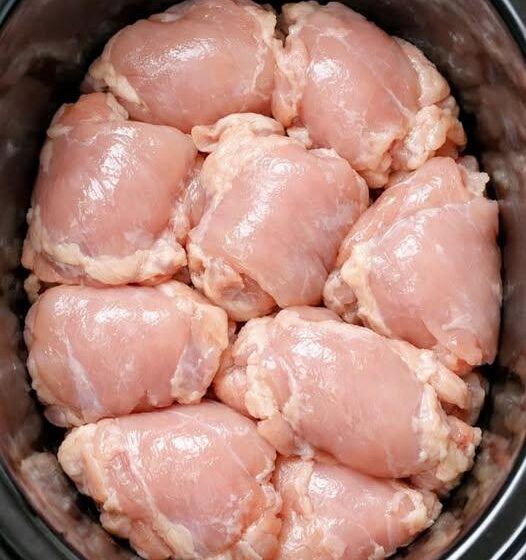
Slow Cooker Honey Dijon Herb Chicken Thighs
Honey and Dijon mustard together over chicken is one of the most reliable flavor combinations in practical home cooking — the honey’s sweetness and floral depth balance the Dijon’s sharp, tangy complexity, and the two together produce a sauce that has more character and more interest than either ingredient alone could manage. Lemon juice adds the acidity that keeps the sweetness and richness in check, chicken broth provides the braising liquid that allows the sauce to develop throughout the long slow cook, and herbes de Provence — the dried blend of thyme, rosemary, savory, marjoram, and often lavender that is one of Southern France’s most distinctive contributions to the spice rack — gives the finished sauce an herbal fragrance that is distinctly spring-like and genuinely inviting.
Chicken thighs are the ideal cut for this preparation. Their higher fat content and connective tissue compared to chicken breasts mean they become more thoroughly tender over the four-to-five-hour LOW cook rather than drying out, and their released juices enrich the honey-Dijon sauce during the braise in a way that lean breast meat cannot replicate. The finished thighs are fork-tender throughout, fully saturated with the fragrant sauce, and ready to serve over whatever starch is convenient — rice, egg noodles, mashed potatoes — with the sauce spooned generously over everything.
Why Honey and Dijon Work So Well Together
The honey-Dijon pairing works for exactly the reason that the best flavor combinations do: each ingredient compensates for what the other lacks and amplifies what the other contributes best. Honey alone over chicken produces something pleasant but one-dimensional — sweet and mild, without the contrast that makes sweetness interesting. Dijon alone is sharp and assertive but can taste flat and slightly bitter without sweetness to balance it. Together, the honey’s sweetness rounds the Dijon’s sharpness and the Dijon’s acidity and complexity cut through the honey’s richness, and the two together produce a sauce with a distinctly balanced sweet-savory-tangy character that is the foundation of many of the most popular French-inspired chicken dishes.
The lemon juice in this recipe adds a third dimension — a clean, bright acidity that is different in character from the Dijon’s sharpness. Where the Dijon’s tartness comes from the wine used in its preparation and has a certain depth and complexity, the lemon’s acidity is cleaner and more immediately refreshing. The two acids together, balanced against the honey’s sweetness and the chicken broth’s savory base, produce a sauce that is genuinely well-rounded rather than merely sweet-and-mustardy.
About Herbes de Provence
Herbes de Provence is a dried herb blend originating in the Provence region of Southern France that typically contains thyme, rosemary, savory, marjoram, and often a small amount of lavender. The lavender, when present, is the component that gives authentic herbes de Provence its distinctive slightly floral, perfumed quality that distinguishes it from simple Italian seasoning or mixed dried herbs. American supermarket versions vary in their lavender content — some include it, some don’t. Versions with lavender produce a noticeably more aromatic, more distinctly spring-like sauce character that is very appropriate for a recipe of this style; versions without lavender are still excellent and produce a more straightforwardly herbal result.
Dried Italian seasoning is an acceptable substitute with a somewhat different but equally pleasant character — the Italian blend typically features basil, oregano, and thyme more prominently without the lavender note of herbes de Provence. Either works well with the honey-Dijon-lemon sauce base. Fresh thyme or rosemary, used at double the dried quantity, can also be substituted for a more vibrant herbal character.
Why You’ll Love This Recipe
Six ingredients, five minutes of preparation, four to five hours of unattended slow cooking, and a result that is genuinely good — tender, juicy chicken thighs in a fragrant, complex sauce with the bright, herbal, slightly floral character that makes it feel appropriate for spring and early summer as well as the colder months when slow cooker meals are most relied upon. The sauce is versatile enough to serve over any starch, and the chicken thighs are forgiving enough of timing variations that the dish works equally well for a weeknight dinner started in the morning or a weekend meal started at noon. It also reheats excellently, making it a good candidate for intentional leftovers.
Ingredient Notes
Boneless, skinless chicken thighs — two and a half pounds — are the protein. The absence of skin is correct for this slow cooker preparation: chicken skin does not crisp in the moist, covered environment of a slow cooker and instead becomes soft and gelatinous in a way most people find unappetizing. Skinless thighs cook to beautiful tenderness without any unpleasant texture from uncrisped skin. Boneless thighs are specified for ease of serving and eating, though bone-in thighs can be used for a slightly richer result — they need an additional 30 to 45 minutes of cooking time and require more work at the table to eat. Arrange the thighs in as close to a single layer as the insert allows so all the thighs have roughly equal access to the sauce and heat.
Honey — one-third cup — provides the primary sweetness and the floral, slightly fruity depth that distinguishes this sauce from a plain mustard preparation. Good-quality honey makes a perceptible difference in the finished sauce — a raw or minimally processed honey with some floral or fruity character is more interesting than a heavily processed clear honey. Clover, wildflower, or orange blossom honey all produce good results. Reduce to one-quarter cup if a less sweet sauce is preferred.
Dijon mustard — three tablespoons — is the sharpness and complexity provider. The full three tablespoons is the correct amount to produce a sauce where the mustard is a clearly present flavor equal partner with the honey rather than a background note. Whole-grain Dijon (sometimes called “country mustard”) can be substituted for a sauce with visible mustard seeds and a slightly coarser, more rustic texture. Yellow mustard produces a milder, sweeter, less complex result that some people — particularly children who find Dijon too sharp — strongly prefer.
Fresh lemon juice — two tablespoons, from approximately one medium lemon — provides the bright acidity that keeps the sauce balanced. Freshly squeezed lemon juice has more aromatic complexity and more vibrant acidity than bottled lemon juice, which often has a slightly flat, cooked flavor. The lemon zest from the squeezed lemon, if added, contributes additional citrus fragrance that is very pleasant in the finished sauce — stir it in along with the juice for a noticeably more aromatic result.
Low-sodium chicken broth — one-quarter cup — provides the additional liquid that keeps the sauce flowing and prevents the honey and Dijon from concentrating too quickly against the insert’s hot walls during the early stages of the cook. It also adds savory depth to the sauce. Low-sodium is specified because the Dijon contains meaningful salt and the sauce should be seasoned to taste at the end rather than starting with a salt-heavy base.
Herbes de Provence — one tablespoon — is the herbal element that gives the dish its distinctive, slightly floral, spring-like character. See the section above for more context on this blend and substitution options.
Ingredients
- 2½ lbs boneless, skinless chicken thighs
- ⅓ cup honey
- 3 tbsp Dijon mustard
- ¼ cup low-sodium chicken broth
- 2 tbsp fresh lemon juice (from about 1 lemon)
- 1 tbsp dried herbes de Provence (or dried Italian seasoning)
- 1 tsp kosher salt, to taste
- ½ tsp freshly ground black pepper, to taste
Step-by-Step Instructions
Step 1 — Arrange the Chicken
Place the boneless, skinless chicken thighs in the slow cooker insert, spreading them in as close to a single layer as the insert accommodates. Some slight overlap is acceptable for a full batch of two and a half pounds; the goal is to keep the thighs as flat and accessible to the sauce as possible rather than stacked in a pile that would cook unevenly. Pat the thighs dry with paper towels before placing — removing surface moisture allows the sauce to adhere more effectively to the chicken.
Step 2 — Make the Sauce
In a small bowl or large measuring cup, whisk together the honey, Dijon mustard, chicken broth, lemon juice, herbes de Provence, salt, and pepper until the mixture is smooth and uniform. Taste the sauce — it should have a good balance of sweet, tangy, and savory. If it tastes too sweet, add another half tablespoon of Dijon or a few drops more lemon juice. If it tastes too sharp or tart, add another teaspoon of honey. Getting the sauce well balanced before it goes into the slow cooker means the finished dish will be seasoned correctly from the start rather than requiring significant adjustment at the end.
Step 3 — Pour and Coat
Pour the sauce evenly over the chicken thighs. Use the back of a spoon to nudge the thighs so some of the sauce seeps underneath them — the underside of each thigh should have sauce contact as well as the top surface. All the chicken surfaces that cook in direct contact with the sauce absorb its flavor more thoroughly than those that are only basted by it from above.
Step 4 — Cook
Cover the slow cooker and cook on LOW for 4 to 5 hours or on HIGH for 2½ to 3 hours. LOW is preferred — the slower, gentler cook produces more uniformly tender thighs and a more developed, more cohesive sauce than the faster HIGH setting. The chicken is done when it is completely tender throughout (the meat separates easily when pressed with a spoon), registers 165°F at the thickest part when tested with a thermometer, and the sauce is actively bubbling. Avoid lifting the lid during the first 3 hours; each opening releases heat and extends the cook time.
Step 5 — Taste and Adjust
Once the chicken is cooked through, open the slow cooker and taste the sauce. The salt level is the most important adjustment — chicken broth and Dijon both contribute salt, but the full amount varies by brand, so always taste before adding more. A squeeze of additional lemon juice at this stage brightens the finished sauce significantly and is worth adding. If the sauce seems thinner than desired, switch to HIGH with the lid off for 10 to 15 minutes to reduce slightly, stirring occasionally. The sauce should be light and spoonable rather than thick, which is appropriate for serving over rice or noodles.
Step 6 — Serve
Serve the chicken thighs hot, spooning the honey-Dijon herb sauce generously over each portion and over the starch it is served with. The sauce is the most flavorful part of the dish and should be distributed liberally. Garnish with a sprinkle of fresh chopped parsley or chives and an additional grind of black pepper if available.
Tips for the Best Results
Taste the sauce before cooking and adjust. The sauce is made from pantry ingredients whose flavor varies by brand and freshness. Tasting the whisked sauce before it goes over the chicken and adjusting the balance — more honey if too sharp, more mustard or lemon if too sweet — takes thirty seconds and ensures the finished dish is well seasoned from the start.
Use LOW rather than HIGH. Chicken thighs cooked on HIGH can become slightly fibrous and less uniformly tender than the same thighs cooked on LOW. The additional two hours of cooking time on LOW is what allows the connective tissue to fully break down and the sauce to properly develop. If the timing allows, LOW is always the better choice for this recipe.
Pat the chicken dry before adding it. Surface moisture on the chicken thighs dilutes the sauce at the beginning of the cook. Thirty seconds of thorough drying with paper towels produces a slightly more concentrated, better-adhering sauce at the end of the cook.
A squeeze of lemon at the end refreshes the sauce. The lemon juice added at the start of the cook loses some of its fresh, bright quality over four to five hours of heat. A small squeeze of additional fresh lemon juice stirred into the finished sauce just before serving — half a tablespoon is sufficient — restores that bright, citrus-forward character that makes the sauce so appealing.
Don’t skip the resting step. Allowing the finished chicken to rest in the covered slow cooker for five minutes after it reaches temperature allows the juices that have been driven toward the surface by the heat to redistribute through the meat, producing more evenly moist thighs when they’re cut or shredded for serving.
Frequently Asked Questions
Can I use chicken breasts instead of thighs?
Yes, with adjustments. Chicken breasts are leaner and less forgiving than thighs in the slow cooker — they’re more prone to drying out if the cook runs long. Use the LOW setting for breast meat and check for doneness at the 3.5-hour mark rather than waiting until 4 to 5 hours. Remove as soon as the internal temperature reaches 165°F — an overcooked chicken breast in a slow cooker becomes dry and stringy quickly. The honey-Dijon sauce is equally good with breast meat; the eating experience is simply more delicate and requires more attention to timing.
Can I use bone-in chicken thighs?
Yes — bone-in, skin-on thighs should have the skin removed before slow cooking (see the ingredient notes above for the reason), but the bone can remain. Bone-in thighs produce a richer, more deeply flavored sauce from the marrow and collagen around the bone that dissolves into the braising liquid during the cook. Increase the cooking time to 5 to 6 hours on LOW for bone-in thighs, and check for tenderness — the meat should pull away from the bone easily when done.
What is herbes de Provence and where do I find it?
Herbes de Provence is a dried herb blend from Southern France, most commonly containing thyme, rosemary, savory, marjoram, and often lavender. It is widely available in the spice aisle of most supermarkets. McCormick produces a widely distributed version. Specialty spice stores often carry versions with a higher lavender content that produces a more aromatic result. If unavailable, dried Italian seasoning is an appropriate substitute at the same quantity.
Can I make this ahead?
Yes. Cook completely, allow to cool, and refrigerate the chicken in the sauce for up to three days. Reheat gently on the stovetop over medium-low heat with the sauce, stirring occasionally, or return to the slow cooker on LOW for 1 to 2 hours. The sauce’s flavor continues to develop overnight and the second-day version is often noticeably more cohesive and more fully flavored than the freshly cooked dish.
Can I thicken the sauce?
Yes. The most straightforward method is the reduction approach: remove the cooked chicken to a plate, switch the slow cooker to HIGH with the lid off, and reduce the sauce for 15 to 20 minutes until it reaches a thicker, more coating consistency. Alternatively, whisk one tablespoon of cornstarch with two tablespoons of cold water until smooth, stir into the hot sauce, and cook on HIGH for 10 minutes until thickened. The reduced version has a more concentrated, more intensely flavored result; the cornstarch version produces a more uniformly thick, glossy sauce.
Variations Worth Trying
Whole-grain mustard version: Replace the smooth Dijon with whole-grain Dijon mustard (sometimes labeled country mustard or grain mustard). The visible mustard seeds add a pleasant textural element to the finished sauce — small pops of slightly sharp, fermented mustard flavor distributed through the sweet, herbal sauce. This version looks more rustic and handmade and is the recommended version for anyone who enjoys the texture of whole mustard seeds.
Tarragon and lemon version: Replace the herbes de Provence with two teaspoons of dried tarragon and add the zest of one lemon to the sauce mixture along with the lemon juice. Tarragon is one of the most classic herb pairings for chicken in French cooking, with an anise-adjacent, slightly sweet herbal flavor that is very distinctive and very good with the honey-Dijon base. This version has a specifically French character that is sophisticated without being complicated.
Orange and honey version: Replace the lemon juice with two tablespoons of fresh orange juice and add a teaspoon of orange zest. Reduce the Dijon to two tablespoons and add one additional tablespoon of honey. The orange’s sweeter, less tart citrus character produces a gentler, more fruity sauce that is particularly good for households with children who find the lemon-and-Dijon combination slightly too assertive. This version pairs particularly well with rice and steamed broccoli alongside.
Garlic and herb version: Add three minced garlic cloves to the sauce mixture before pouring over the chicken. The garlic mellows considerably over the four-to-five-hour LOW cook, losing its sharpness and becoming sweet and savory rather than pungent. The combination of honey, Dijon, garlic, and herbes de Provence produces a more complex, more deeply savory sauce that is a particularly good pairing with mashed potatoes.
Creamy Dijon version: Stir two to three tablespoons of heavy cream into the finished sauce after removing the cooked chicken, swirling it through the hot braising liquid until incorporated. Return the chicken to the pot briefly to warm in the enriched sauce. The cream produces a richer, more luxurious sauce with a rounded, dairy-softened character that is excellent over egg noodles.
Serving Suggestions
Honey Dijon herb chicken thighs are most satisfying served over something starchy that absorbs the fragrant sauce. Steamed jasmine rice is the simplest and most effective option — its mild, slightly floral quality complements the sauce’s herbal and honey notes rather than competing with them. Buttered egg noodles are an equally satisfying alternative with a richer, more substantial base that carries the sauce beautifully. Mashed potatoes produce the most indulgent presentation. For a lighter, more spring-appropriate accompaniment, serve over a bed of wilted baby spinach or arugula — the heat of the sauce wilts the greens slightly and the greens’ slight bitterness provides excellent contrast to the sauce’s sweetness.
Green vegetables that work well alongside this dish include roasted asparagus, steamed green beans, sautéed zucchini, or a simple green salad with lemon vinaigrette. The lemon in the salad dressing echoes the citrus note in the sauce and makes the plate feel cohesive. For bread, warm baguette or soft dinner rolls are natural companions for a dish this sauce-forward — there will be sauce worth capturing at the end of the plate.
Storage
Store leftover chicken in the sauce in an airtight container in the refrigerator for up to three days. The sauce continues to season the chicken during storage and the second-day version is reliably better than the freshly cooked one. Reheat gently over medium-low heat on the stovetop with the sauce, adding a splash of chicken broth if the sauce has thickened significantly. Freeze for up to two months — the chicken and sauce freeze well together; thaw overnight in the refrigerator before reheating. A squeeze of fresh lemon juice after reheating restores the bright, citrus-forward quality that diminishes during storage and freezing.
Six Ingredients, One Sauce Worth Making Again
Slow Cooker Honey Dijon Herb Chicken Thighs is a recipe that earns its place in the regular weeknight rotation by producing a result that is both reliably good and genuinely interesting to eat — not merely filling and easy, but actually flavored with the kind of balance and brightness that makes people ask what’s in the sauce. Honey and Dijon balanced with lemon and brightened with the herbal, slightly floral character of herbes de Provence produce something that tastes considered rather than assembled, and the slow cooker’s gentle four-to-five-hour braise is what allows the sauce to become a cohesive, unified thing rather than its original three or four separate components. That combination of good flavors and good technique, from six pantry ingredients and a morning’s worth of unattended cooking, is what makes this one worth keeping.
Enjoy!