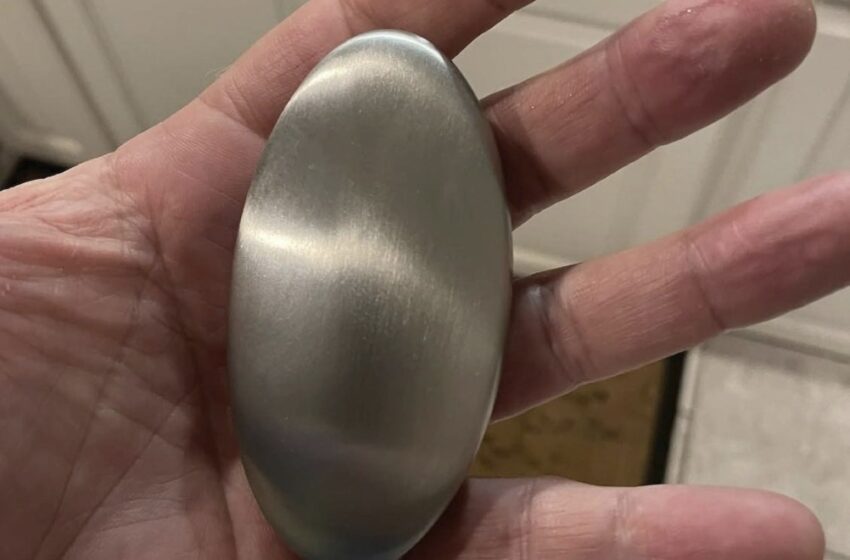
You’ve seen it: a smooth, oval lump of stainless steel sitting in a dish near the sink. It looks like soap—but cold, hard, and metallic. And if you’ve ever chopped garlic, onions, or fish, you know why it’s there: it banishes stubborn food odors from your hands like magic.
But is it actually magic? Let’s explore the science—and whether it really works.
🔬 How It Works: The Chemistry of Odor Removal
The offensive smells from garlic, onions, and fish come from sulfur compounds:
Allicin (garlic)
Thiosulfinates (onions)
Trimethylamine (fish)
These molecules bind strongly to skin proteins—and soap alone often can’t break those bonds completely.
Stainless steel’s superpower: When you rub wet hands on stainless steel under running water, a redox reaction occurs:
Iron/chromium in the steel binds to sulfur compounds
This converts smelly sulfur molecules into odorless iron sulfide
Running water washes away the neutralized compounds
💡 Key insight: It’s not the steel itself—it’s the chemical reaction between steel + water + sulfur that neutralizes odors.
✅ Does It Actually Work? (Spoiler: Yes—With Caveats)
Study/Anecdote
Finding
MythBusters (2008)
Confirmed stainless steel removes garlic/onion odors better than soap alone
University of Hamburg (2007)
Demonstrated sulfur compounds bind to steel surfaces in lab settings
Real-world use
Works best on fresh odors (within 5–10 mins of handling food)
⚠️ Limitations:
Less effective on dried-in odors (wash first with soap, then use steel)
Doesn’t work on non-sulfur smells (e.g., gasoline, paint)
Requires friction + running water—just holding it won’t help
🧼 How to Use It Properly (The Right Way):
For Complete Cooking STEPS Please Head On Over To Next Page Or Open button (>) and don’t forget to SHARE with your Facebook friends
Wet your hands thoroughly
Rub the stainless steel bar vigorously for 20–30 seconds under cold running water
→ Focus on fingertips, nails, and palms where odors cling
Rinse well
Dry hands—no lingering smell!
✨ Pro tip: Keep the steel bar clean and dry between uses. Wash with soap occasionally to remove residue.
🛒 What to Look For (Not All “Steel Soaps” Are Equal)
Feature
Why It Matters
100% stainless steel (no coatings)
Coatings prevent the redox reaction—must be bare metal
Ergonomic shape (oval, grooved)
Easier to grip and rub than a plain spoon/fork
Holder included
Keeps it dry and accessible by the sink
💡 Budget hack: No special bar? Rub hands on the side of a stainless steel sink, a spoon, or faucet—same chemistry!
❌ Myths Debunked
Myth
Reality
“It’s just placebo effect”
❌ Lab studies confirm the chemical reaction occurs
“Any metal works”
❌ Only stainless steel (iron + chromium) creates the right reaction. Aluminum/copper won’t work.
“It replaces handwashing”
❌ Always wash with soap first—steel only targets sulfur odors, not bacteria/grease
🌿 Eco-Friendly Bonus
Zero waste: Lasts decades—no plastic bottles or refills
Chemical-free: No synthetic fragrances or harsh scrubbers
Cost-effective: One-time purchase vs. endless soap refills
💬 Final Thought: Simple Science, Real Results
That little steel bar isn’t magic—it’s clever chemistry. And in a world of complicated solutions, it’s refreshing to have a tool that’s as simple as rubbing your hands on metal under running water.
So next time garlic lingers on your fingers, skip the lemon juice or coffee grounds. Reach for the steel. Your nose (and dinner guests) will thank you.
“The best solutions aren’t always the fanciest. Sometimes, they’re just stainless steel and running water.”
Have a steel soap bar? Share your favorite brand—or your DIY hack (spoon, sink, faucet?) below!
You’ve seen them.
Every modern bathroom has them.
Two buttons on the toilet tank — one big, one small.
And if you’re like most people, you might press both… or just one… without really thinking about it.
But here’s the truth:
👉 Those two buttons aren’t just design flair.
They’re part of a smart system called a dual flush toilet — one of the simplest ways to save water, cut bills, and reduce your environmental footprint.
Let’s break down how they actually work — so you can stop guessing and start saving.
Because real sustainability isn’t about grand gestures.
It’s about small choices — like which button you press. 💧
🔍 How Dual Flush Toilets Work (The Smart Way)
Dual flush toilets give you two flushing options — each designed for a different type of waste:
✅
Large Button (Full Flush)
For solid waste
~6–9 liters (1.6–2.4 gallons)
✅
Small Button (Half Flush)
For liquid waste
~3–4.5 liters (0.8–1.2 gallons)
💡 By choosing the right flush, you avoid using double the water when you don’t need to.
🔁 Pro Tip: If the half-flush doesn’t clear the bowl, wait 10 seconds and try again — don’t automatically hit both buttons!
💧 The Real Impact: Why This Matters
For Complete Cooking STEPS Please Head On Over To Next Page Or Open button (>) and don’t forget to SHARE with your Facebook friends