- Prep Time: 30 minutes (plus 1 hour for initial rising)
- Cold Fermentation (Retard): 12 to 24 hours (optional but recommended)
- Boil & Bake Time: 30 minutes
- Total Time: Approx. 14 to 26 hours (mostly inactive)
- Intensity: Moderate
- Skill Level: Intermediate
Why Intensity Matters
This recipe is rated Moderate. The dough is stiff and requires some elbow grease if kneading by hand. The two main technical hurdles are:
- Dough Hydration: Bagel dough is much drier (approx. 55% hydration) than standard bread dough. It will feel tough and shaggy initially; resist the urge to add more flour or water. Proper kneading develops the gluten necessary for that signature chew.
- The Boil: Managing a pot of simmering malt water while shaping bagels requires coordination. The boil sets the crust and prevents the bagels from over-expanding in the oven.
Ingredients
For the Dough
- 4 cups (520g) Bread Flour: High-protein flour is essential for chewiness. All-purpose flour will result in a softer, less traditional texture.
- 1 ½ cups (360ml) Warm Water: Approximately 105°F to 110°F.
- 2 teaspoons (6g) Instant Yeast: Or 2 ¼ teaspoons active dry yeast (if using active dry, proof it in the water with a pinch of sugar first).
- 1 tablespoon (15g) Barley Malt Syrup: This is the secret ingredient. It adds flavor, color, and feeds the yeast. Honey or dark brown sugar can be substituted in a pinch, but malt syrup is preferred.
- 1 ½ teaspoons (9g) Sea Salt
- Neutral Oil: For greasing the bowl.
For the Boil & Toppings
- 8 cups Water
- 1 tablespoon Barley Malt Syrup: (Or 1 tablespoon baking soda—malt syrup yields a better crust flavor).
- 1 tablespoon Honey: Optional, adds shine.
- Toppings: Sesame seeds, poppy seeds, everything bagel seasoning, flaky sea salt, or dried minced onion.
Instructions
Day 1 (Or 4 Hours Before Baking)
1. Make the Dough (Intensity: High)
In a large mixing bowl, whisk the bread flour and instant yeast together. In a separate bowl, combine the warm water, 1 tablespoon of barley malt syrup, and salt. Pour the wet ingredients into the dry ingredients. Stir with a wooden spoon until a shaggy, stiff dough forms.
Transfer the dough to a clean work surface. Knead for 10 to 12 minutes. The dough will feel very stiff and resistant at first. Continue kneading until the dough becomes smooth, elastic, and passes the “windowpane test” (stretch a small piece thin enough to see light through it without tearing).
2. First Rise (Intensity: Low)
Form the dough into a tight ball. Lightly grease the mixing bowl with oil, place the dough inside, and cover with plastic wrap or a damp towel. Let it rise at room temperature until it has puffed up and increased in size by about 50% (it likely will not double, as bagel dough is dense). This takes approximately 60 to 90 minutes.
3. Shaping (Intensity: Moderate)
Turn the dough out onto a clean surface (do not flour heavily). Divide the dough into 12 equal pieces, roughly 3.5 to 4 ounces each.
- Method 1 (Rope & Loop): Roll each piece into a rope about 8 inches long. Wrap the rope around your hand, overlapping the ends by about 2 inches. Roll the overlapped seam under your palm to seal.
- Method 2 (Poke a Hole): Roll each piece into a smooth ball. Poke your floured thumb through the center and gently stretch the hole to about 1 ½ inches in diameter.
Place the shaped bagels on a parchment-lined baking sheet. Cover loosely with plastic wrap.
4. Cold Fermentation (Retard) – Optional but Recommended (Intensity: None)
Refrigerate the shaped bagels overnight for 12 to 24 hours. This develops complex sour notes and makes the bagels easier to handle when boiling. If skipping this step, let the shaped bagels rest at room temperature for 20 to 30 minutes before the boil.
Day 2 (Baking Day)
5. Preheat & Prepare (Intensity: Low)
Preheat your oven to 450°F (230°C) . If you have a baking stone, place it on the middle rack. If not, invert a heavy baking sheet and place it in the oven to preheat. Fill a large, wide pot (at least 5 quarts) with the 8 cups of water. Bring it to a boil.
6. The Boil (Intensity: High)
This step requires focus. Work in batches.
Add the 1 tablespoon of barley malt syrup and honey to the boiling water. Reduce the heat to a simmer (rolling boil can deflate the bagels).
If your bagels were refrigerated, remove them and let them sit at room temperature while the water heats. They may have floated slightly; this is fine.
Carefully place 3 to 4 bagels into the simmering water. They will sink initially, then float to the top in about 30 seconds. Boil for 45 seconds per side for a soft, thin crust. Boil for 60 to 90 seconds per side for a very chewy, thick crust.
Remove the bagels with a slotted spider or skimmer, letting excess water drip off, and return them to the parchment-lined baking sheet (not the hot stone/pan yet).
7. Topping (Intensity: Low)
Immediately after boiling, sprinkle your chosen toppings onto the wet bagels. The sticky, gelatinized surface acts as glue. Do this while they are still wet; if the bagels dry, the toppings will fall off.
8. Baking (Intensity: Low)
Carefully transfer the bagels (on the parchment) onto the preheated baking stone or inverted baking sheet. If using a standard baking sheet, place the parchment directly on it.
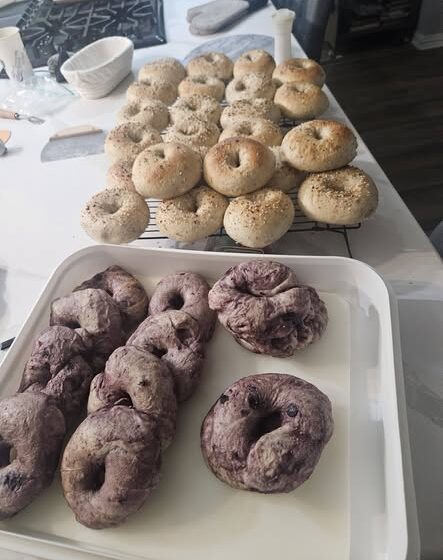
Bake for 12 minutes. Rotate the pan and bake for another 8 to 12 minutes, until the bagels are a deep, burnished golden brown. If you used malt syrup in the boil, they should have a glossy, blistered crust.
9. Cool (Intensity: None)
Transfer the bagels to a wire rack. Do not cut into them for at least 15 minutes. The interior is still setting; cutting too soon can result in a gummy texture.
Nutrition Information
Note: Nutritional values are estimates per bagel (1 of 12) and do not include toppings.
| Nutrient | Amount |
|---|---|
| Calories | 245 kcal |
| Carbohydrates | 48 g |
| Protein | 9 g |
| Fat | 1 g |
| Saturated Fat | 0.2 g |
| Sodium | 290 mg |
| Fiber | 2 g |
| Sugar | 2 g |